Documented case · Regulation (EC) No 261/2004

Flight cancelled at 11:41.
You had until 09:25 to decide.

The airline is not to blame for a volcanic eruption. It is answerable for how it treated its passengers afterwards. This page sets two things side by side: what European law requires in that situation — and what actually happened.

What this is about

On 8 August 2026 my wife and I were checked in and at the gate for flight W4 6534 Prague–Catania. An eruption of Mount Etna closed the airspace over eastern Sicily and arrivals were suspended. That is an extraordinary circumstance and nobody holds it against the airline — no right to compensation under Article 7 arose and I am not claiming any.

But an extraordinary circumstance only relieves the carrier of the duty to pay compensation. The duty to carry the passenger to their destination, to look after them and to refund their money continues — and that is precisely the moment at which a passenger is most dependent on the airline. The Court of Justice of the EU confirmed this after the Icelandic eruption of 2010.

Below are fourteen points at which, in my view, the carrier's conduct departed from those duties. For each, the left-hand column is what I believe should have happened, the right-hand column is what did happen, and beneath it the specific provision or judgment I rely on. Most points are evidenced by the carrier's own written statements or screenshots of its own interface.

2 h 16 minafter scheduled departure we were told the flight was cancelled
7 daysthe carrier's nearest available capacity — half of a two-week holiday
3×separately evidenced restrictions of rerouting to the carrier's own flights
CZK 16,106paid for the booking; refunded as credit, and for the outbound leg only

I am publishing this because the same thing happens to everyone whose flight is cancelled by a volcano, fog or a strike. I will gladly share the documents and case-law references with anyone dealing with the same problem.

8 August 2026 · W4 6534 · Prague → Catania · times CEST

09:25Scheduled departureChecked in, at the gate
morningEtna erupts, airspace closed, arrivals into Catania suspendedExtraordinary circumstance
11:41Airline announced the cancellation+2 h 16 min after departure
12:11Cause given: eruption of Mount EtnaSecond e-mail
~12:00Onward bookings cancelled to limit the penaltiesAirport still closed at the time
afternoonCatania airport reopenedOperations resumed
9 AugOutbound fare converted into credit — no consent, no choice offeredReturn flight left active
10 AugFlights to Catania cancelled again, including another carrier's service from PragueNo alternative existed
11 AugThe same flight W4 6534 from Prague was diverted to ComisoRerouting was possible

Credit towards buying further tickets was uploaded to the account automatically. The airline justified this on the grounds that the passenger had not selected another option before the scheduled time of departure. We only learned that the flight had been cancelled two hours and sixteen minutes after that moment.

What should have happened, and what did

None of the points below is about the volcano. All of them are about what followed it. The label on each says what it rests on: Carrier's own words is its own written statement, Evidenced is a screenshot or document, Legal opinion is my reading of the documented facts.

01

Leave the choice to the passenger — all three options, not a menu of the carrier's own making

Carrier's own words

Should have happened

Article 8(1) does not give the carrier the right to choose the remedy. It gives the passenger a choice of three: (a) reimbursement of the ticket price, (b) rerouting to the destination at the earliest opportunity, (c) rerouting at a later date at the passenger's convenience.

The carrier should have asked which of them I wanted.

Art. 8(1), Regulation (EC) No 261/2004 — full text

What happened

The outbound fare was automatically converted into credit towards further tickets with the same carrier. Options (b) and (c) thereby disappeared — the decision that we would not fly at all was not the passenger's, it was the carrier's.

Its own system meanwhile showed availability on 15 and 18 August at a fare difference of zero. Nobody asked whether I wanted those.
02

Do not condition a remedy on something that cannot be done

Carrier's own words

Should have happened

Credit instead of money is permissible only with the passenger's signed agreement. Without it, the ticket price is reimbursed in money.

Any condition the carrier imposes must be capable of being met at the time the passenger is expected to act.

Art. 8(1)(a), Regulation 261/2004

What happened

The credit was uploaded automatically, and the carrier justified it in writing as follows:

“…we are uploading those automatically to your WIZZ account as no other option was selected by you prior to the scheduled departure time of your original flight.”
— airline e-mail, 9 August 2026

Scheduled departure was 09:25. The carrier told us of the cancellation at 11:41. The condition was therefore objectively impossible to satisfy — at 09:25 I could not have held the information on which such a choice would be made.

03

Reroute at the earliest opportunity, including on a competitor's flight

Evidenced

Should have happened

Rerouting “at the earliest opportunity under comparable transport conditions” is an obligation of result, not of means. The Court of Justice of the EU has held that the carrier must use all the means at its disposal, including the search for direct and indirect flights which may be operated by other air carriers.

Art. 8(1)(b) · CJEU C-74/19 (TAP) · Commission Interpretative Guidelines 2016/C 214/04

What happened

The offer was confined to the carrier's own flights — at three independent points, in its own words:

“rebook to another flight operated by Wizz Air on the same or a comparable route”
— airline e-mail, 8 August 2026, 11:41
“re-book onto another flight operated by us”
— banner in the flight-change interface

The carrier's nearest available capacity was 15 August, seven days after departure. The 11 August flight was sold out. Other carriers were flying into the destination region the very next day — Prague–Catania from CZK 3,009 (about €120), less than the carrier was offering to refund for the outbound leg alone.

04

Offer an alternative airport in the same region

Evidenced

Should have happened

The Regulation expressly contemplates an alternative airport: where the passenger accepts a flight to another airport serving the same region, the carrier bears the cost of transferring them from there to the original destination.

It would have been enough to offer: we will land at another Sicilian airport and take you on from there.

Art. 8(3), Regulation 261/2004

What happened

No alternative airport was offered — not in the e-mail, not in the booking system, not in the flight-change interface.

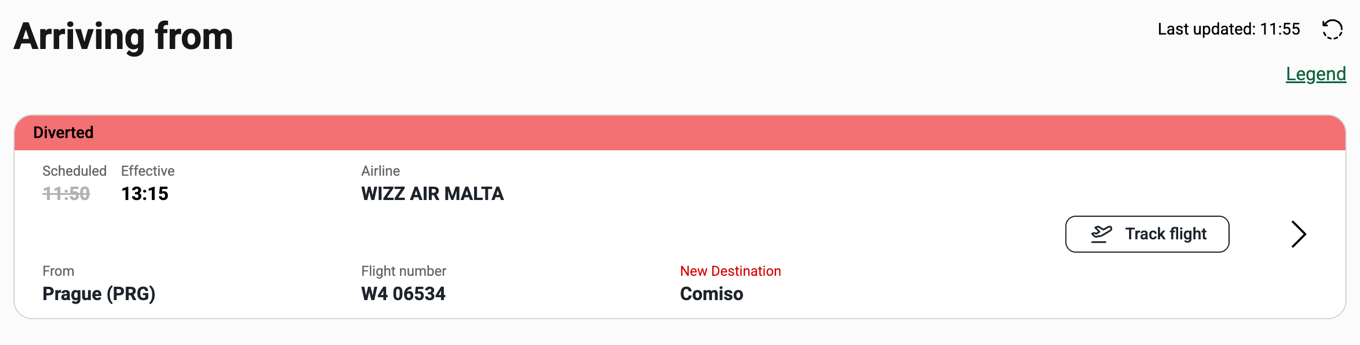
Three days later the carrier diverted the very same flight to an alternative airport. On 11 August 2026 flight W4 6534 from Prague was diverted to Comiso, an airport some 90 km from Catania:

Catania airport arrivals board, 11 August 2026: flight W4 06534 from Prague, WIZZ AIR MALTA, status Diverted, new destination Comiso.
Arrivals, Aeroporto di Catania, 11 August 2026, 11:55 — status Diverted, W4 06534 from Prague, new destination Comiso. Source: aeroporto.catania.it

I therefore consider that rerouting to another Sicilian airport was among the reasonable measures the carrier ought to have considered on 8 August. If it was not possible that day, it should have said so — instead, no such offer was made at all.

05

Do not present an incomplete list of options as complete

Evidenced

Should have happened

When a carrier informs a passenger what options they have, it must not omit the options the law gives them. For a professional whose business is governed by Regulation 261/2004 as a basic instrument, the standard of care is judged more strictly.

Art. 8, Regulation 261/2004 · misleading omission under Czech Act No 634/1992 on consumer protection, ss. 4, 5, 5a

What happened

The booking overview in the carrier's app presented the list as closed:

“Your options are the following: rebook your flight, or request refund.”
— booking overview in the airline's app

Rerouting with another carrier, or to another airport, was not among the “options”. We acted on that information — the onward bookings were cancelled because it appeared no other possibility existed.

06

The “comparable route” on offer should have existed

Evidenced

Should have happened

An offer of rerouting “on the same or a comparable route” must be a real offer — that is, it must contain an available date under comparable transport conditions.

Art. 8(1)(b), Regulation 261/2004

What happened

For Palermo — the other Sicilian airport — the carrier's booking system showed no date at all in August. The first available was in September, after the holiday would have ended.

The “comparable route” was therefore empty. It is not that the earliest opportunity was inconvenient; there was none.

07

Do not shift the finding and funding of replacement carriage onto the passenger

Legal opinion

Should have happened

Article 8 reads “passengers shall be offered the choice”. The duty to offer and to provide carriage lies with the operating carrier. The passenger is not obliged to search for flights or to fund them out of their own pocket.

Buying one's own ticket and claiming reimbursement later is a fallback where the carrier fails in its duty — not the primary route.

Art. 8(1), Regulation 261/2004 · CJEU C-74/19

What happened

The passenger was left with a choice between accepting a flight a week later, or finding and paying for other carriage himself and hoping to be reimbursed.

The carrier did not state that a competitor's flight could be requested, nor that the cost of a transfer from an alternative airport would be borne by it.

08

Provide any channel at all for claiming a cash refund

Evidenced

Should have happened

If the passenger has a statutory right of choice, there must be a route by which to exercise it. A right that cannot be exercised is not a right.

Art. 8(1)(a) read with Art. 15, Regulation 261/2004

What happened

Three independent channels, none of which leads to money:

Self-service interface — the only button is labelled “REQUEST WIZZ CREDIT REFUND” and yields credit exclusively.

Chatbot — on a refund query it referred to a status checker. Nobody responded to the “talk to an agent” option.

Complaint form — its list of categories contains no item for reimbursement of a fare on a flight cancelled by the carrier. The only category with a per-flight selector requires receipts for meals or accommodation to be uploaded; without them the form cannot be submitted.

09

Refund within seven days

Carrier's own words

Should have happened

Reimbursement of the ticket price is made within seven days, in cash, by electronic bank transfer, bank order or bank cheque.

Art. 8(1)(a) read with Art. 7(3), Regulation 261/2004

What happened

Instead of a deadline, the carrier stated in writing:

“due to current worldwide situation processing of this request will take significantly longer”
— airline e-mail, 9 August 2026

The wording comes from a pandemic-era template and is being used in August 2026. “Significantly longer”, with no end point given, does not replace the statutory seven days.

10

Settle the whole booking, not half of it

Evidenced

Should have happened

The Regulation expressly contemplates that after a cancellation the remaining parts of the journey no longer serve any purpose in relation to the original travel plan — their fares are reimbursed too. A return ticket from Catania is worthless without the journey to Catania.

Art. 8(1)(a), second limb, Regulation 261/2004

What happened

The carrier settled the outbound leg only. The return flight two weeks later remained in the system as “Confirmed” — even though the passenger had no way of reaching its point of departure.

If the passenger does not turn up, the system records a no-show and the return fare is forfeited. As it happens, it is the more expensive of the two.

11

Refund the amount that was paid, in the currency it was paid in

Evidenced

Should have happened

The Regulation speaks of reimbursement of “the full cost of the ticket at the price at which it was bought”. The booking was paid in Czech crowns, so the refund belongs in crowns and in the original amount.

Art. 8(1)(a), Regulation 261/2004

What happened

The credit was issued in euros — at a rate the passenger neither approved nor chose.

To get money back to the card, a second conversion takes place with a further spread. Both are at the passenger's expense.

12

Allow the passenger to reply

Evidenced

Should have happened

Where a carrier notifies a passenger of a decision about their money, the passenger should be able to respond to that same notification.

Art. 15, Regulation 261/2004 · the principle that a right must be exercisable

What happened

The e-mail announcing the credit came from a no-reply address. The carrier also publishes no e-mail address for complaints.

Disagreement therefore cannot be expressed by the route the notification arrived on — only again through a form whose categories do not fit the case.

13

Do not pass your own obligations to the passenger

Carrier's own words

Should have happened

Rights under the Regulation accrue to each passenger individually against the carrier. The carrier owes duties of information and of payment to each of them.

Arts. 8 and 14, Regulation 261/2004

What happened

“It is your responsibility to inform all other passengers within the above booking and share the WIZZ credit among them if necessary”
— airline e-mail, 9 August 2026

The duty to inform fellow passengers and to divide the remedy among them was thus transferred to the booking holder. I find no basis for that transfer in the Regulation.

14

Cite terms that apply — and make the link go where it says

Evidenced

Should have happened

If an interface links to contractual terms, the link should lead to contractual terms, and those should be the terms of the carrier with whom the contract was made.

Czech Civil Code ss. 1811 and 1813 · Directive 93/13/EEC on unfair contract terms

What happened

The link labelled “Terms and Conditions” in the refund dialogue led to the privacy notice — verifiable from the page source.

The document the carrier points to as its website terms was moreover issued by a different legal entity than the contracting carrier, and was last updated in 2015.

At another checkbox of the same carrier both links are labelled correctly. This is therefore not a convention but an error.

A pattern that repeats. On two independent occasions the remedy was made conditional on something the passenger could not do: the credit was uploaded because he “did not select another option before the scheduled departure time” — two hours before he learned of the cancellation. And for the hire car, the intermediary's terms required him to call “directly from the counter” — a counter in Sicily he never reached, because the only flight there was cancelled.

In both cases the condition is drafted so that it can be met in normal operation, and cannot be met in precisely the situation it is meant to govern.

What I rely on

Regulation (EC) No 261/2004

Art. 5(3) extraordinary circumstances · Art. 7 compensation · Art. 8 passenger's choice and rerouting · Art. 8(3) alternative airport · Art. 9 care · Art. 12 further compensation · Art. 14 duty to inform · Art. 15 rights cannot be waived.

CJEU C-12/11 McDonagh v Ryanair

The Icelandic volcano, 2010. An eruption is an extraordinary circumstance, so no compensation arises. But the duty of care towards passengers applies with no limit in time or money even then. This judgment is the foundation of this page: an extraordinary circumstance cancels compensation, not obligations.

CJEU C-74/19 (TAP)

In rerouting, a carrier must use all the means at its disposal, including the search for direct and indirect flights which may be operated by other air carriers. The only limit is “intolerable sacrifices” given the capacities of the undertaking — which this carrier has not evidenced here.

Commission Interpretative Guidelines 2016/C 214/04

In looking for the “earliest opportunity” the carrier should consider flights of other carriers and other modes of transport. Not binding law, but the Commission's reading grounded in case law.

CJEU C-83/10 Sousa Rodríguez

Article 12 preserves the right to seek further compensation under national law. Accepting a remedy under the Regulation is therefore not a settlement of the whole matter.

CJEU C-204/08 Rehder

A passenger may sue the carrier at the place of departure — here the Czech Republic — regardless of where the carrier is established and of what its terms say about jurisdiction.

The UK regulator vs the same carrier, 2023

The UK Civil Aviation Authority took enforcement action against this carrier precisely over its failure to offer rerouting and care. The carrier signed undertakings to change its practices; a review of 25,486 claims followed, with payments of over £1.24m. This is therefore not one clerk's one-off mistake.

Czech law

Civil Code s. 2910 damages · s. 2903 duty to mitigate · s. 1813 unfair terms · Act No 634/1992, ss. 4, 5, 5a unfair commercial practices.

What European law says

A volcano cancels compensation. Not obligations.

In an extraordinary circumstance — a volcano, closed airspace, extreme weather — no right to €250–600 in compensation arises. That is correct and nobody disputes it.

But after the Icelandic eruption of 2010 the Court of Justice of the EU held that the duty to carry the passenger to their destination and to look after them applies even then, with no limit in time or money. That is precisely the moment at which a passenger is most dependent on the airline.

Rerouting “at the earliest opportunity”

Article 8 gives the passenger the choice between a refund and carriage to the final destination at the earliest opportunity, under comparable transport conditions.

Under the European Commission's interpretative guidelines the airline must also consider flights operated by other carriers, and other modes of transport. If it flies you to a different airport in the same region, it also pays for the transfer from it.

Money, not a voucher

A refund of the ticket price is paid in money within seven days. A voucher or credit is permissible only with the passenger's signed agreement — that is, only where you expressly choose it.

Credit uploaded automatically because you “did not respond” does not meet that condition.

Rights cannot be waived

Article 15 provides that obligations towards passengers may not be limited or waived. Accepting a remedy is therefore not a settlement.

A passenger who was not properly informed of their rights, and accepted less for that reason, may still claim the difference afterwards.

Your flight was cancelled? Do this

  1. Back up the evidence immediately

    Save the airline's e-mails as PDF. Screenshot what the app offers you, which dates are available and what competitors charge. Within days it is gone and cannot be reconstructed. Capture the date and time within the image itself.

  2. Ask in writing for what you are entitled to

    Either rerouting at the earliest opportunity — expressly including other carriers' flights and alternative airports under Article 8(3) — or reimbursement in money to the original means of payment. Not by phone. In writing, dated.

  3. Do not accept a voucher by silence

    If credit is uploaded automatically, state that you did not request it and do not consent. Do apply to convert it into money, but on the record and with your rights expressly reserved — otherwise you risk losing the value when it expires.

  4. Check the return flight too

    When the outbound is cancelled, the return ticket often stays in the system as valid. If you do not turn up, it is forfeited. Ask expressly for the whole booking to be settled.

  5. Complain to the national enforcement body

    It is free and takes fifteen minutes. Every EU state has a national enforcement body for Regulation 261/2004, competent for flights departing from it. One complaint is an incident. Fifty complaints are a systemic problem the authority has to address — that is exactly how the UK regulator's pressure arose in 2023.

    National enforcement bodies

I will not invite you to “join a lawsuit” — in the Czech Republic collective proceedings can only be brought by a registered non-profit body, not by an individual. Your own complaint to the regulator carries more weight in practice.

Frequently asked questions

If it was caused by a volcano, am I entitled to nothing?

You are not entitled to financial compensation under Article 7. Your right to carriage to your destination, to care while waiting and to reimbursement of the fare remains in full. An extraordinary circumstance relieves the carrier of the duty to pay compensation, not of the duty to take you where it sold you a ticket to.

Must the airline reroute me on a competitor's flight?

The duty under Article 8 is to provide carriage to the destination “at the earliest opportunity”. It is an obligation of result, not of means. In C-74/19 the Court of Justice of the EU held that the carrier must use all the means at its disposal, including the search for flights which may be operated by other air carriers. That the carrier has no agreement with its competitors is its operational problem, not a statutory exemption.

Do I have to buy the replacement ticket myself and claim it back?

No. The Regulation places the duty to provide rerouting on the carrier. The passenger is not obliged to search for flights or to pre-fund them. Buying your own ticket and claiming reimbursement is a fallback for where the carrier fails in its duty — not the primary route.

Can they give me credit instead of money?

Only with your signed agreement. Under Article 8(1)(a) the fare is reimbursed in cash, by electronic bank transfer, bank order or cheque, within seven days. A voucher is an exception conditional on prior agreement — not a default position you have to opt out of.

Can the airline fly me to a different airport?

Yes, and in many situations it is the most sensible solution. Article 8(3) expressly contemplates it: if you accept a flight to another airport serving the same region, the carrier bears the cost of transferring you from there to your original destination or to another nearby place agreed with you. It is not a concession you should accept at a loss — it is a full remedy at the carrier's expense.

Do I lose my right to damages by accepting a remedy?

No. Article 12 expressly preserves the right to further compensation under national law, and Article 15 provides that rights under the Regulation cannot be waived. It is still advisable to reserve your rights expressly in writing. Note a different consequence: if you choose reimbursement, the carrier's duty to carry you ends — you cannot have both.

Where do I turn if the airline does not respond?

First a written complaint to the carrier — without it the supervisory bodies will not take the matter up. Then the national enforcement body for the country of departure, the European Consumer Centre for out-of-court resolution, and the consumer protection authority. Where the carrier is licensed in another member state, a complaint may also be made to that state's authority. Claims up to €5,000 can be pursued under the European Small Claims Procedure — in writing, by form, without a lawyer.